Wednesday, 30 June 2010

White-letter Hairstreak (Satyrium w-album)


Both my White-letter Hairstreaks have emerged this week.
This is the best photograph that I managed to achieve yesterday evening before this second individual flew off to the top of my garden elm tree.
*
A superb little butterfly!

Saturday, 26 June 2010

White-banded Drone Fly (Volucella pellucens)

I took this photograph yesterday afternoon whilst looking for Currant Clearwings on my blackcurrant bushes. I think it is the White-banded Drone Fly (Volucella pellucens).

I only realised that it was a hoverfly after seeing a photograph of a similar insect (Leucozona lucorum) in the British Wildlife magazine that arrived this week. In the magazine Roger Morris (joint organiser of the Hoverfly Recording Scheme) has written an article about web-based natural history recording. He comments that weblogs and networking sites represent a new form of natural-history society. The Yorkshire Naturalists Union (of which I am a member) also gets a mention in the article where it is given as an example of the traditional natural-history society, maintaining a database and having a network of county recorders. What a shame that, even after studying my YNU list of recorders, I am not immediately sure who I could email this photo to with the essential labels: locality, date, grid reference and recorder's name.

The Yorkshire Naturalists Union's Lepidoptera Group has made advances in the collation of electronic records of both butterflies and moths. Howard Frost should be given credit for devising the Butterfly Conservation Yorkshire Branch members' network of Vice-County co-ordinators which enables butterfly records to be uploaded via the Levana program. Charlie Fletcher has been the main catalyst behind the success of Yorkshire's Mapmate-based moth recording system. Harry Beaumont and Philip Winter provide a wealth of experience and knowledge and are able to advise when photography alone is insufficient for reliable identification of specimens.
I suspect that the Pyralid moth photographed here is Scoparia ambigualis. It emerged from the moss on my coal bunker yesterday. I suppose that another possibility would be Eudonia truncicolella, another moss-feeder which Harry has identified for me before now. To be sure of the identity of this moth I could have sent the specimen to Harry or Charlie but can anyone have a stab at it from the photo?
*
Post Script: It didn't take long for Charlie Fletcher and Tony Davis on the Yorkshiremoths yahoogroup to confirm that this moth is indeed Eudonia truncicolella. The pointed forewings are the give-away sign.

Sunday, 20 June 2010

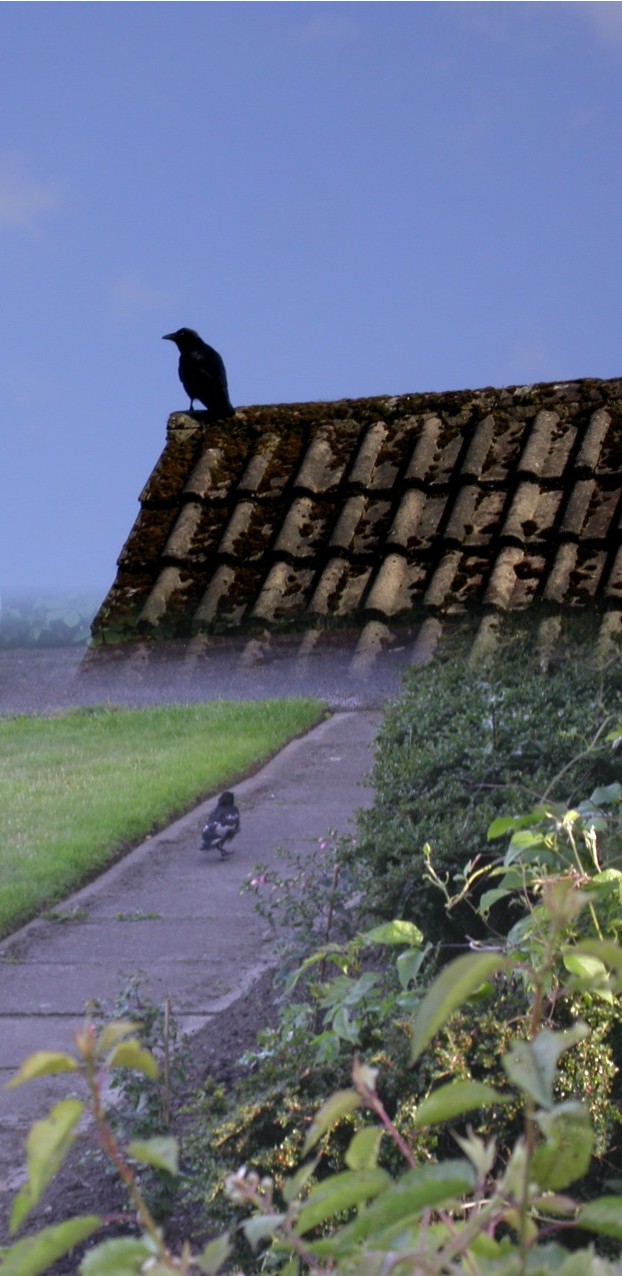
The Vigilance of a Crow


The composite photograph above provides a record of my wander around the back garden this morning with a Nikon 4500.

From left-to-right are Bird's-foot trefoil, Selfheal, Tormentil, Salad Burnet flower, Light Emerald pupa, damaged Speckled Wood butterfly, unidentified hoverfly, probable Epiphas postvitana caterpillar on Agrimony, Enchanter's Nightshade and Mullein flowers.
***********
Meanwhile all hell is let loose when Ziggy the cat ventures into the front garden. A not-yet-fledged Carrion Crow appears to have fallen from its nest and is now resident in a territory of four gardens, associated driveways and the pavements inbetween.
Both parents make an enormous racket and dive-bomb the unfortunate cat if he goes within 50 yards of their flightless offspring.
My next-door neighbour is providing water and egg-based foods for the youngster whose gait has developed over the last few days from an initial stagger, stagger, flop-onto-face to the now confident jaunty swagger.

Common White Wave


This Common White Wave (Cabera pusaria) has emerged on 17th June. The caterpillar came from birch on Penistone Hill, near Haworth VC63. It was found on a rainy day during the first week of September 2009.

I had worked out the species from the well-documented description of the brown-form larva; having a greenish central part of the flattened head.

At the same wind-swept location, on the same day, I found an Iron Prominent caterpillar (also on birch) and a Narrow-winged Pug caterpillar on the flowering heather (smaller photograph, also featured on page 105 of Yorkshire Butterflies & Moths 2009).

Wednesday, 16 June 2010

Moths on the Cherry Tree


I have just noticed the first Cherry Fruit Moths (Argyresthia pruniella) of the year flitting around the vicinity of my front garden cherry tree. They are a little bit too active to photograph in the lunchtime sunshine so this roosting Poplar Hawkmoth was chosen as an alternative subject.
The Poplar Hawkmoth is a regular visitor to light-traps at this time of year and often feature on the Yorkshire Butterfly Conservation's "Recent Sightings" page.

Friday, 11 June 2010

A Brimstone in Esholt


The Brimstone (Gonepteryx rhamni) is a rare butterfly in the Bradford area, so when I passed one in Esholt today, I jumped out of the car and took a photograph with my BlackBerry.
The male butterfly was nectaring on Rhododendron flowers at the western approach to Esholt Sewage Works. I'm rapidly having to revise my opinion of Rhododendrons which I had previously held to be useless for wildlife.
I know where Alder Buckthorns (Frangula alnus) have been planted in the sewage works so I will be looking for caterpillars over the next couple of months.

Sunday, 6 June 2010

Scalloped Hazel


When I do turn my moth trap on at this time of year I seem to catch an extraordinary number of Scalloped Hazel (Odontopera bidentata).
I have never quite worked out why this should be the case and although my garden (and those of my neighbours) contain the appropriate wide range of woody foodplants, I have never yet found the larvae.
In Butterflies and Moths of Yorkshire Stephen Sutton reports that "the larvae are sometimes conspicuous in privet hedges in city areas" but I live on a 1960's estate where privet is uncommon.
I must remember to try beating the garden hawthorn in late August and maybe also the birch, oak and conifers.
Jim Porter (Caterpillars of The British Isles) suggests that breeding stock can be obtained "from fertile female adults which often attend light traps in reasonable numbers." As there were twenty adults in my trap last night I might keep some for a few days and see if any lay eggs.